What Are Plinko Odds?
In Plinko, “odds” usually refer to two different things:
- the probability of landing in a specific slot
- the payout attached to that outcome
When people talk about odds in Plinko, they’re usually mixing together a few different ideas that don’t actually mean the same thing. There’s probability — the chance that the ball lands in a specific slot — and then there’s the payout tied to that outcome. The confusion starts when those two get treated as if they’re interchangeable, which makes the game seem either more generous or more random than it really is.
Plinko doesn’t operate on simple “win or lose” logic. Every drop feeds into a distribution in which some outcomes appear constantly, while others sit on the far edges, showing up so rarely that they almost feel theoretical. That’s why thinking of it as a 50/50 scenario completely misses the point. Most of the action happens in the middle of the board, where returns are smaller but far more frequent, while the high multipliers exist on the margins as low-probability events.
Once you separate the idea of “how often something happens” from “how much it pays,” the structure of the game starts to make more sense. Plinko isn’t about predicting a single drop — it’s about understanding how outcomes are distributed over time.
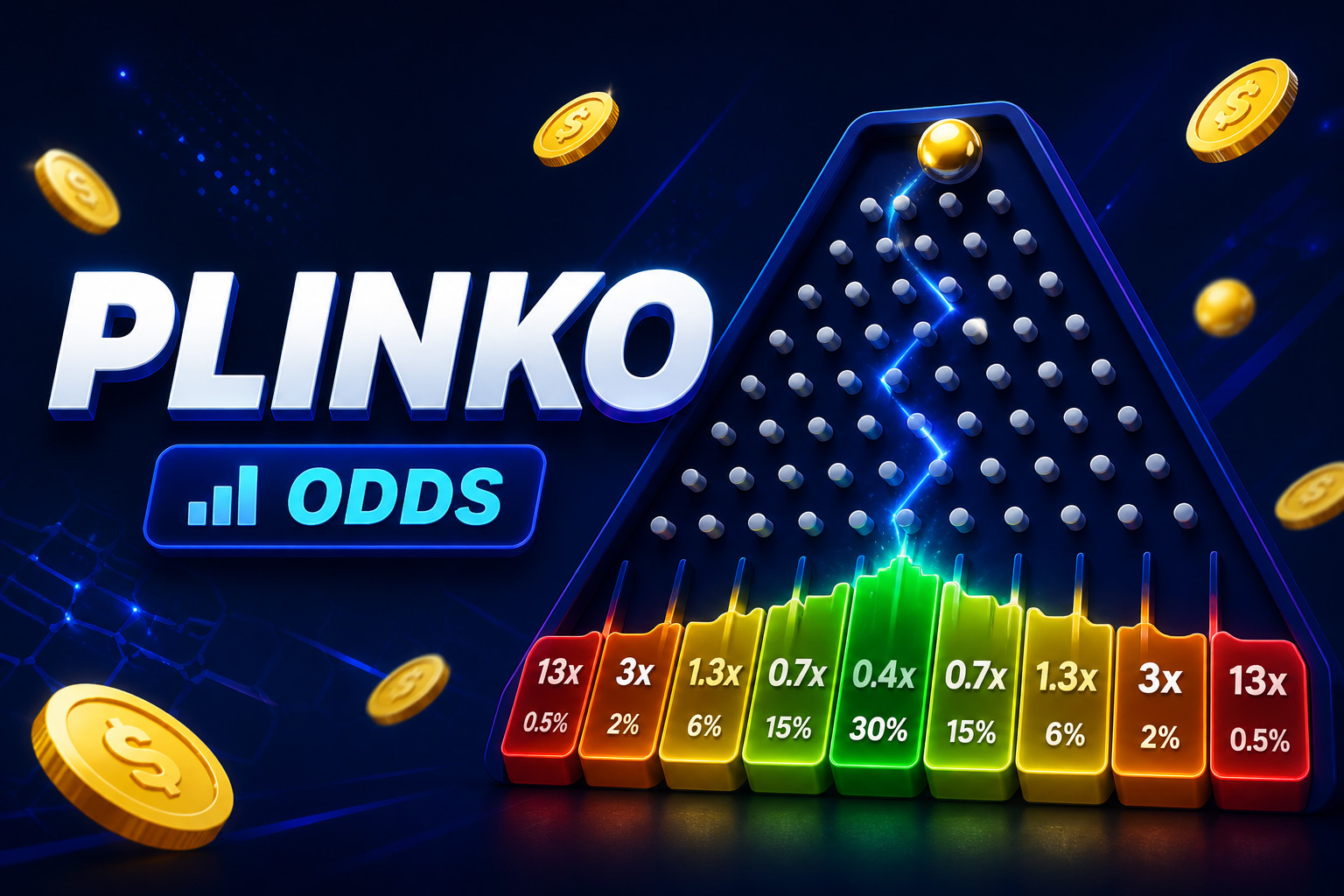
How Probability Works in Plinko
At first glance, each drop in Plinko looks chaotic. The ball hits one peg, then another, bouncing left and right in a way that feels unpredictable. But underneath that randomness sits a very stable statistical pattern. Each collision slightly redirects the ball, and while any single path is impossible to track, the overall behavior across many drops follows a consistent distribution.
This is where Plinko becomes “random, but not messy.” The ball doesn’t have memory, and it doesn’t react to previous outcomes, but the structure of the board ensures that certain paths are more likely than others. Every time the ball hits a peg, it effectively makes a tiny binary decision — left or right — and over multiple rows, these decisions stack into a probability model rather than pure chaos.
Because of this, the game feels unpredictable in the short term but surprisingly stable over longer sessions. You might see unusual streaks or clusters of results, but zoom out far enough and the distribution begins to normalize. That’s the part many players miss: randomness in Plinko doesn’t mean anything can happen equally often — it means outcomes follow a pattern you can’t influence, but can absolutely understand.
The Bell Curve Explained (Core Concept)
If there’s one idea that explains almost everything about Plinko odds, it’s the bell curve. You don’t see it directly on the board, but it’s there in the background, shaping how outcomes are distributed. Most balls tend to land somewhere near the center, while the extreme edges — where the highest multipliers usually sit — are hit far less often.
This isn’t accidental. Every time the ball hits a peg, it slightly shifts left or right, and over many rows those tiny movements start to accumulate into a pattern. The more rows there are, the more pronounced this effect becomes. Instead of outcomes being evenly spread across the board, they cluster toward the middle, forming that familiar “hill” shape when you look at the results over time.
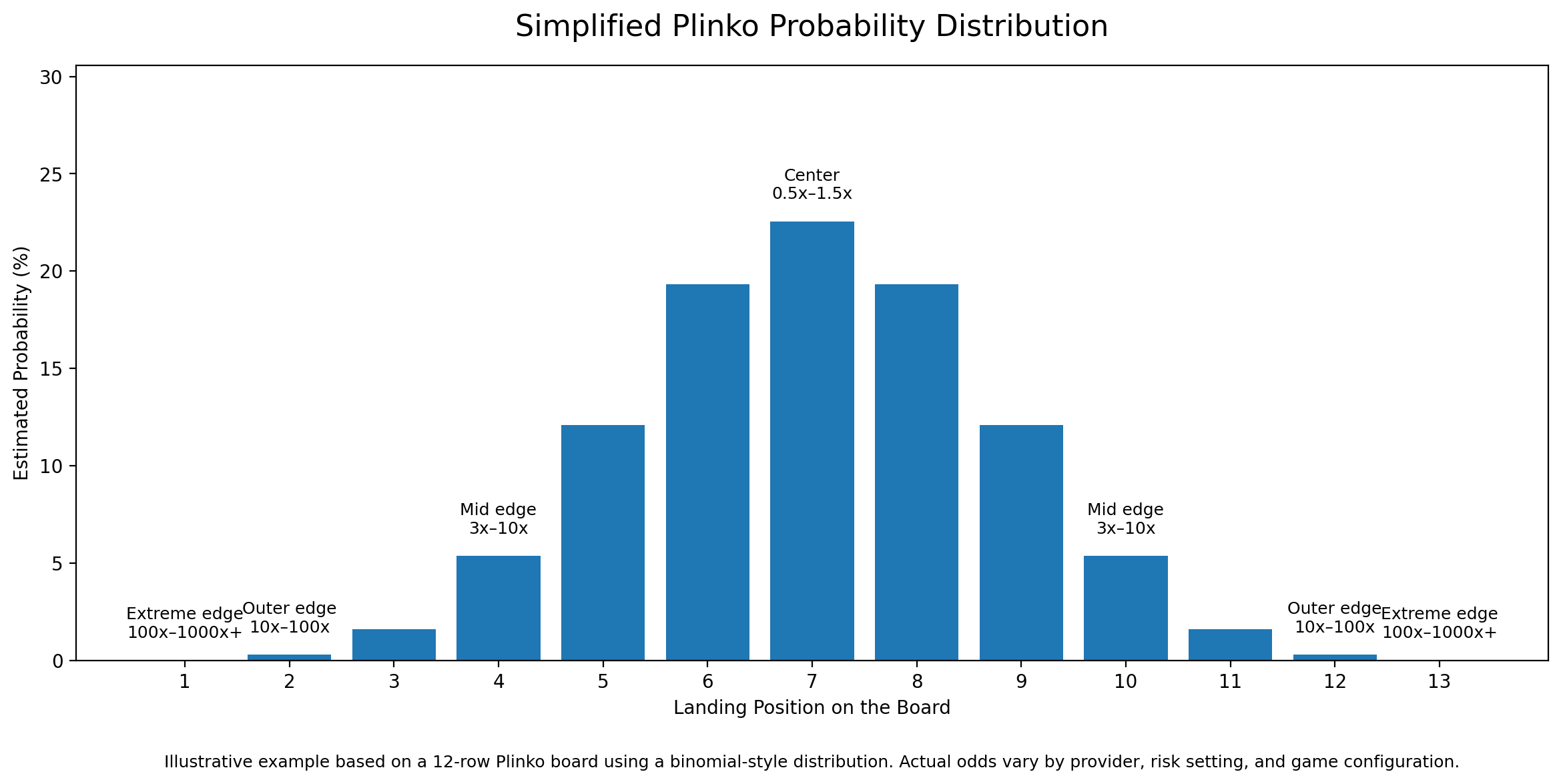
Example Plinko probability distribution: most outcomes cluster near the centre, while extreme edge multipliers appear much less often. Actual odds vary by provider, board size, risk level, and game configuration.
What makes this important is how it changes expectations. Players often focus on the outer multipliers because they look exciting, but mathematically, those are the least likely places for the ball to end up. The center isn’t just “common” — it’s dominant. Once you understand that, the game stops feeling random in a vague sense and starts to look like a system where probability quietly pulls everything toward a predictable structure.
| Board Position |
Relative Probability |
Typical Multiplier |
| Center (middle slots) |
~30%–40% |
0.5x – 1.5x |
| Near center |
~20%–30% |
1.5x – 3x |
| Mid edges |
~10%–15% |
3x – 10x |
| Outer edges |
~3%–7% |
10x – 100x |
| Extreme edges |
<1% |
100x – 1000x+ |
Plinko Board Mathematics (Simplified)
You don’t need to dive deep into formulas to understand how Plinko works, but there is a clear mathematical foundation behind it. Each row of pegs represents a series of tiny branching paths, where the ball effectively chooses left or right at every step. When you stack those decisions across multiple rows, you get a structure that resembles a probability tree.
This is closely related to what’s known as the Pascal triangle, where each position represents the number of ways a certain outcome can occur. In simple terms, there are many more paths that lead to the center of the board than to the edges. That’s why central slots are hit more frequently — not because the game is biased, but because there are simply more routes that lead there.
As the number of rows increases, this effect becomes stronger. The distribution tightens, the center becomes even more dominant, and the outer edges become increasingly rare. That’s why two Plinko games with the same basic idea can feel completely different depending on how the board is structured. The math doesn’t change, but its impact becomes more visible.
Risk Levels and Their Impact on Odds
Changing the risk level in Plinko doesn’t alter the game’s randomness, but it does reshape how outcomes are distributed. This is one of the most misunderstood parts of the system because the RTP often stays the same, making it seem like nothing really changes. In reality, the experience can shift dramatically.
At lower risk levels, payouts are distributed more evenly across the board. The multipliers tend to be smaller but appear more often, creating a smoother and more stable session. You don’t see big spikes, but you also don’t experience long gaps without returns.
Higher risk settings move things in the opposite direction. The center becomes less rewarding, while the edges carry much larger multipliers. This doesn’t increase your overall chances of winning, but it concentrates potential returns into fewer, more impactful events. The result is a more volatile session, with long losing streaks possible and occasional large hits.
What matters here isn’t which option is “better,” but how each one changes the shape of the distribution. You’re not changing the odds of the system — you’re changing how those odds are expressed during gameplay.
| Risk Level |
Hit Frequency |
Avg Payout Size |
Volatility |
Player Experience |
| Low |
High |
Small |
Low |
Stable, predictable |
| Medium |
Moderate |
Balanced |
Medium |
Mixed sessions |
| High |
Low |
Large |
High |
Spiky, unpredictable |
RTP vs Probability – What’s the Difference?
One of the biggest misunderstandings in Plinko comes from treating RTP as if it describes what will happen in your session. In reality, RTP is a long-term expectation, not a short-term guarantee. It tells you how much of the total wagered amount is theoretically returned over an extremely large number of rounds, but it says nothing about how those returns are distributed in the moment.
Probability works on a different level. It defines how likely a specific outcome is — for example, how often the ball lands near the center versus the edges. RTP sits above that, summarizing the overall return after all those probabilities have played out over time. The two are connected, but they don’t operate on the same timescale.
This is why a game with a high RTP can still feel unforgiving during a session. If the volatility is high, most of the return is concentrated in rare outcomes, meaning you can go through long stretches without seeing that theoretical value. On the other hand, a lower-volatility setup may feel more stable even if the RTP is identical, simply because returns are more evenly distributed.
Understanding this separation is key. RTP answers the question “what happens eventually,” while probability and volatility explain “how it gets there.” Mixing the two leads to unrealistic expectations, especially in a fast-paced game like Plinko.
Multiplier Distribution in Plinko
Every Plinko board is essentially a map of probabilities translated into payouts. The multipliers aren’t placed randomly — they reflect how likely each landing position is. Slots near the center tend to have smaller multipliers because they are hit more often, while the outer slots offer higher payouts precisely because they are harder to reach.
This creates an intentional imbalance. The game compensates for low probability with higher rewards, and vice versa. What matters is not just the size of a multiplier, but how frequently it can realistically appear. A 1000x payout might look appealing, but if the probability of reaching that slot is extremely low, it becomes more of a statistical outlier than a consistent opportunity.
Over time, the distribution of multipliers reveals the true nature of the game. Most sessions are built on a foundation of smaller returns, with occasional deviations when higher multipliers are hit. This is why focusing only on the biggest numbers can be misleading — they represent the edges of the system, not its core.
Real Odds Example (With Numbers)
To make this more concrete, imagine a Plinko board with multiple rows where the center slots are reached far more often than the outer edges. While exact probabilities vary depending on the game, the general pattern remains consistent: outcomes cluster toward the middle, and the chance of hitting the far ends drops off sharply.
For example, landing in one of the central slots might occur in a significant percentage of rounds, while reaching the outermost slots could happen only a tiny fraction of the time. This doesn’t mean it won’t happen — just that it happens rarely enough to stand out when it does.
What this highlights is the difference between possibility and expectation. The game allows for extreme outcomes, but it doesn’t distribute them evenly. If you observe enough rounds, the pattern becomes clear: frequent small results, occasional medium ones, and rare spikes that define the upper range of payouts.
| Multiplier |
Estimated Probability |
| 0.5x |
~25% |
| 1x |
~30% |
| 2x |
~20% |
| 5x |
~10% |
| 10x |
~5% |
| 50x |
~1%–2% |
| 100x+ |
<1% |
Does Plinko Have Patterns?
It’s easy to feel like Plinko develops patterns, especially during longer sessions. You might notice streaks where results cluster in one area of the board, or periods when nothing significant happens. The natural reaction is to assume that something is “building up” or that the game is shifting in a predictable way.
In reality, these patterns are an illusion created by randomness itself. When outcomes are generated independently, clusters and streaks are not only possible — they are expected. The human brain is wired to find structure, even when none exists, which makes random sequences feel meaningful.
This is closely tied to the gambler’s fallacy, in which past results are believed to influence future outcomes. In Plinko, each drop is independent, and the board doesn’t “remember” where the ball landed before. What looks like a pattern is simply the natural variation within a random system.
Recognizing this doesn’t make the game predictable, but it does remove a layer of false expectation. Instead of trying to read patterns, it becomes more useful to understand the underlying distribution and accept that short-term sequences don’t change long-term probabilities.
Can You Predict Plinko Outcomes?
The short answer is no, but the reason why is more interesting than it looks at first glance. Each drop in Plinko is an independent event, meaning the path the ball takes is not influenced by what happened before. Even if two drops look similar at the start, small variations in how the ball interacts with the pegs quickly lead to completely different outcomes.
What creates confusion is the fact that the game doesn’t feel entirely chaotic. Because of the underlying distribution, you can anticipate that most results will fall somewhere near the center. That creates a sense of “almost predictability,” as if the system is leaning in a certain direction. But that’s not the same as predicting a specific outcome — it’s just recognizing where outcomes are more likely to cluster over time.
Trying to forecast individual drops is where the logic breaks down. The system has structure, but no memory. You can understand the shape of the distribution, but you can’t track or influence the path of a single ball. That distinction is what separates informed expectations from false confidence.
Plinko vs Other Probability Games
Looking at Plinko next to other casino games helps clarify what makes it unique. Unlike slots, which are driven by reel combinations and hidden mechanics, Plinko exposes its randomness more visually. You can literally see the ball bouncing through the system, which makes the outcome feel more tangible, even though it’s still governed by probability.
Compared to roulette, the difference becomes even clearer. Roulette has fixed odds tied to a wheel with a known number of outcomes, while Plinko operates on a distribution that emerges from repeated binary decisions. In roulette, each number has a clearly defined probability. In Plinko, probability is shaped by the board’s structure rather than by a fixed set of outcomes.
Crash games introduce another contrast. They involve timing and player interaction, which creates the illusion of control. Plinko removes that layer entirely. Once the ball is dropped, there is nothing left to influence, and all decisions happen before the round begins. This shifts the focus away from reaction and toward setup.
These comparisons don’t make one game better than another, but they highlight how Plinko sits somewhere between visibility and randomness. You can see the process, but you can’t control it.
| Game Type |
Outcome Speed |
Player Control |
Probability Type |
| Plinko |
Very fast |
Low |
Distribution-based |
| Slots |
Medium |
None |
RNG cycles |
| Roulette |
Slow |
Medium |
Fixed odds |
| Crash |
Fast |
High |
Timing-based |
How Game Design Affects Odds
Even though the core mechanic stays the same, the way a Plinko game is designed can change how it behaves in practice. The number of rows, the spacing between pegs, and the way multipliers are assigned all influence how outcomes are distributed.
Adding more rows increases the number of decisions the ball makes as it falls, which tightens the distribution and makes the center even more dominant. Fewer rows create a looser structure, where outcomes spread out more evenly across the board. This doesn’t remove randomness, but it changes how concentrated the results become.
The placement of multipliers also plays a role. Some games emphasize extreme outcomes by placing higher values at the edges, while others keep the distribution more balanced. These design choices don’t alter the underlying probability model, but they shape how players experience it during a session.
In practice, this means two Plinko games can feel very different even if they follow the same basic rules. The math is consistent, but the way it is presented changes how that math is perceived.
How Speed Changes Perceived Odds
Speed doesn’t change probability, but it changes how you experience it. In a slow game, outcomes are spaced out, giving you time to process each result. In a fast game like Plinko, especially with autoplay enabled, results arrive in rapid succession, compressing the experience.
This compression makes variance more visible. A sequence that would take hours to unfold in a slower format can happen within minutes in Plinko. Losing streaks feel sharper, and winning moments feel more intense, simply because they are happening closer together.
This also affects perception. When results come quickly, it becomes easier to believe that something is “off” or that the game is behaving differently than expected. In reality, the probability hasn’t changed — you’re just seeing more of it in a shorter period of time.
Understanding this helps separate what the game is doing from how it feels. The math remains constant, but the pace amplifies its effects.
Common Misunderstandings About Plinko Odds
Some of the most common misconceptions include:
- believing the game “balances out” in the short term
- thinking near-misses increase future chances
- assuming streaks indicate a pattern
Most confusion around Plinko doesn’t come from the math itself, but from how people interpret what they see during play. One of the most persistent ideas is that the game somehow “balances out” in the short term, as if a series of low results increases the chance of a higher one appearing next. In reality, each drop is independent, and the system doesn’t adjust itself based on previous outcomes.
Another common misconception is the feeling of being “close” to a big win. When the ball lands just next to a high multiplier, it can create the impression that the outcome was almost achieved, as if it could have easily gone the other way. But in probabilistic terms, there is no such thing as “almost.” The ball either follows a path that leads to that slot or it doesn’t, and near misses don’t carry any predictive value.
There’s also a tendency to overestimate the frequency of extreme outcomes. High multipliers stand out and are remembered more clearly, while the steady stream of smaller results fades into the background. Over time, this creates a distorted view of how often those big payouts actually occur.
What all of these misunderstandings have in common is a mismatch between perception and probability. The game behaves consistently, but the way results are experienced can make it feel otherwise.
Practical Takeaways (What Actually Matters)
Once you strip away the noise, Plinko becomes much easier to understand. The game is built on a stable probability structure in which most outcomes cluster around the center, while extreme results occur on the edges as low-frequency events. That doesn’t change from session to session, even if individual results vary.
What tends to matter more than the raw odds is how those odds are distributed. Volatility shapes the experience far more than RTP does in the short term, and the way a session unfolds largely depends on how risk is configured before the first drop. Trying to react to outcomes mid-session usually leads to inconsistent decisions, because the underlying probabilities aren’t shifting in response.
The most useful way to approach Plinko is not to look for an advantage, but to understand the framework it operates within. Once you accept that the system is fixed and outcomes are independent, the focus naturally shifts toward managing exposure rather than predicting results. That’s where the game becomes clearer — not easier to win, but easier to navigate without false assumptions.
In practice, what matters most is:
- understanding distribution, not chasing outcomes
- focusing on volatility rather than isolated wins
- keeping session structure consistent